A Bicycle for the Heart
Stories about spring, cats, a bicycle, and sitting in gum.
Welcome to the last Scattering of February. We have nearly made it. All goodwill and strength to those who have started fasting in this most desolate of all the months.
This week's story perhaps has a little of The Third Policeman in it, but I think it mainly expresses the banal truth that you never seem to get a puncture on a day that is otherwise going really well.
This week’s daily stories
Monday
The writing was smaller than usual, and neater too. It sat right in the middle of an empty page, like a signpost. “I know you read my diary.” He thought: she can’t know. He thought: it’s a joke, it’s just in case. But he knew that he could never speak to her again. His voice would give him away.
Tuesday
When I got back home the windows were boarded over. Not a repossession: the notice on the door showed my life was no longer a going concern. I worried about where I would sleep and what I would eat, but as the night passed I found it didn’t seem to matter. A little later, a new notice went up: under new management. Some investor had come in to turn the sinking ship of my existence around. I hoped they had a little more nous than the last guy.
Wednesday
I saw the first hints of blossom, like the branch-tips had been dipped in violet ink. Too soon. I need a few more weeks to hide in the dark, to numb my toes. I am not ready for brighter days just yet. But I saw two daffodils, too, and a sunbeam fell warm on my neck. I cannot stop things getting better.
Thursday
I found him shivering on the balcony. “I had to get out,” he explained, “but I should have gone for the front door.” Twenty minutes later and I would have found him climbing down the building. I got him a blanket and a cup of tea, then I moved a few things around, changed a painting over, put a pan of soup on. By the time he could smell it, he was ready to come back in.
Friday
The city receded. Cities, like mountains, don’t look smaller as you move away. Instead you see the unbearable scale of them, and they look bigger than ever. As we passed out of sight of it, it seemed to grow and grow, a little larger each time we looked back. It only shrank again when I went back.
Saturday
The cats stared at each other and I stared at the cats. Slowly, like a leaf towards the sun, one of them turned away. I couldn’t say if it was an entente or a surrender. They stayed near each other a while, enemies or friends or some third cat thing that I couldn’t understand, until the bang of a bin lid sent them running in opposite directions. I hoped, if there was a winner, that mine had won.
Sunday
I was at the bus shelter with the missing roof, waiting, and I had just sat in gum. I knew that I had sat in gum because a minute before I had looked at the foul grey blob of it clinging to the seat and thought, make sure you don't sit there. But the world span the thought out of me as quickly as it had come, and I sat. The bus came, late, and I waved the driver on. The gum would only become a problem when I stood up, so I stayed, stuck in place, until I could think my way out of it ever having happened.
I have been reading...
- Monumenta by Lara Haworth, an odd little novel, dreamlike while also prominently featuring sequences of dreaming/hallucination, so that its moment of plain, tangible reality are all the more prominent.
- Decolonising the Mind by Ngũgĩ wa Thiong’o. Ngũgĩ, who died last year, was a Kenyan novelist. He was imprisoned without trial for his writing, and subsequently chose to stop writing in English and write only in Gikũyũ and Kiswahili. This short, potent book brings together the thinking about language, literature and colonialism that led to that decision.
- Les Misérables by Victor Hugo (translated by Norman Denny). I tried reading this when I was young and didn't get far; I'm not sure how much that was my age and how much was the translation available in the school library. I'm not entirely sure about this translation, either, but it has the advantage of being the one that I have. Expect to see this one hanging around this section for a few weeks.
If you buy books linked to from Scattering, I may earn a commission from Bookshop.org, whose fees support independent bookshops.
This week’s story: A Bicycle for the Heart
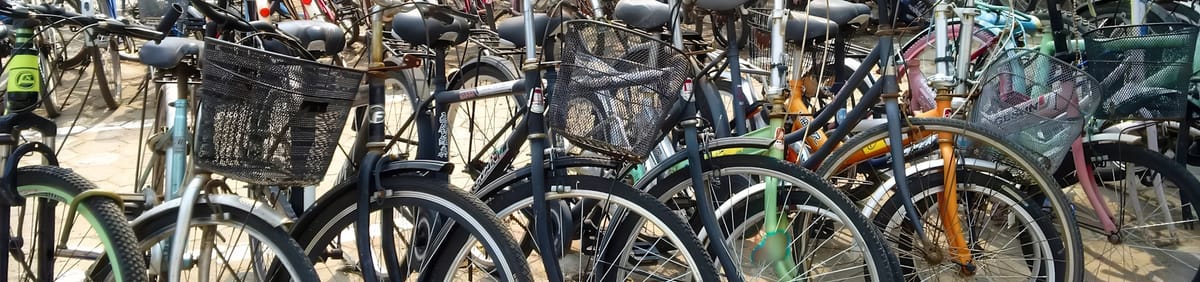
The state of my spirit seemed always to be reflected in the state of my bicycle: a flat tyre on a bad day, clunking gears when I couldn't be other than clumsy, slack brakes when the world was hurtling past me. When the sun shone in my heart the cranks turned smoothly and I could ride with no hands. And so I took to calling my therapist my bike mechanic and my bike mechanic my therapist. It was, at times, confusing, but I think it did me good. I got my bike serviced more often that way, and I took a more practical approach to matters of mental health, knowing that the parts of my mind I cleaned and greased would always need re-cleaning and re-greasing after the winter.