Separate Containers
Stories about sourness wars, living under the sea, a stupid argument and a trip to the tip.
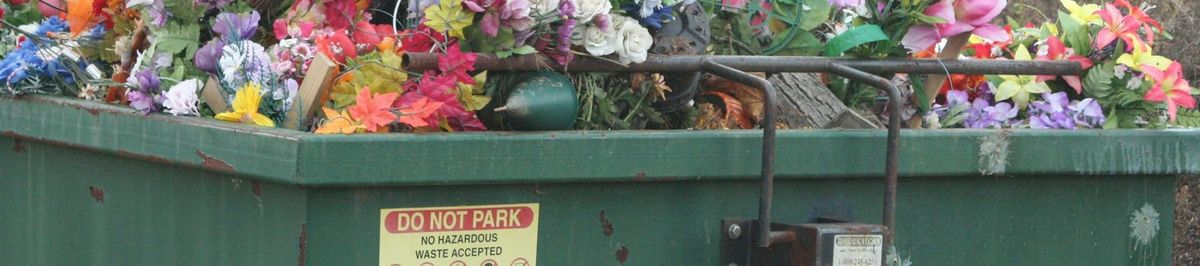
This week's story is about the tip. I like the tip: perhaps this is my inheritance as a dad, or perhaps it is simply that the tip, like the library, is one of the few true community spaces we have left. For more on the tip, see this story.
This week’s daily stories
Monday
The sweetshops had grown more competitive all through summer, carrying on long after the children calmed. The sourest sweets in the village, the country, the country, the world. The proprietors were seen on social media with tears in their eyes and smiling, bleeding mouths. A boy went in for jelly babies and they added a scoop of citric acid to the bag. By the end of the holidays, both were closed: one owner bankrupt, one laid out with chronic indigestion.
Tuesday
I wished to live in grids from the first time my birthday was marked on a calendar, from noughts and crosses to chess to go. In school I loved when they brought out graph paper in maths, or even for handwriting practice: fitting all those curls and scratches into perfect squares. I hated when they brought it with the scrap paper for a wet playtime, and it got drawn on howsoever. I dream of enclosed fields, of a square apartment on an American city block, a pixel-perfect image of the world. Or failing that, I might make do with prison.
Wednesday
In my eighth year under the sea I began to dream about leaks. I knew that I was dreaming because I saw the water coming in, heard the trickle, felt the wetness in my socks. If there was truly a leak it would be over faster than waking, my little world smeared flat by the weight of the ocean. I worried that a slow leak in my dreams meant death slowly growing in my body. I did not want to die sealed up tight. Give me the catastrophe, that I might feed the deep like a whale fall.
Thursday
We spent a happy afternoon arguing about the helicopter, he that it was a model close by, I that it was real but distant. We talked about flight time and engine noise and rotor speed and all sorts of other things we knew nothing about, and the wronger we felt the harder we argued, until the sun began to set and we compromised. It was a half-scale helicopter, monkey-piloted, a middling way away.
Friday
When Sadie was bad they sat her in front of the mirror. To stare into the mirror at any other time would have been dreadful vanity, but to do it in shame was quite different. It fascinated her to see her iris move, her nostrils twitch with breath, her skin curve and fold: so much complexity, and not a wisp of badness in it.
Saturday
For my birthday she gave me a book about secret languages. What it means to wear a certain flower or colour or perfume. How the way a letter is folded might show love, respect, contempt, forgiveness. I turned the pages and looked at the reused silver gift wrap it came in, and I wondered: what does this mean?
Sunday
For just one week I lived my nightmares. Went to work in my pants and let deadlines breeze past my bare skin. Sent the wrong words to the wrong people. When they asked me to leave, I drove home from the back seat. When such absurd fears become real, they lose their hold over you. I sleep dreamlessly now, but I hope to wake up soon.
I have been reading...
- Luckenbooth by Jenni Fagan, which tells the stories of the residents of an Edinburgh tenement across 90 years. It's an odd novel, full of destabilising shifts in tone and genre, and little anachronisms that give it a strange sense of unreality. The supernatural parts end up feeling more real than the rest – but I think that suits it.
- The current issue of Forgotten Ground Regained, a journal of alliterative poetry. I was introduced to the journal because my friend Lindy Newns has a poem in this issue that I like very much (two, in fact), but the whole journal is a delight, a clear labour of love. A real gem (or a pearl, if you prefer).
If you buy books linked to from Scattering, I may earn a commission from Bookshop.org, whose fees support independent bookshops.
Separate Containers
Around two o'clock one of the guys from the tip comes over to my open window. "Excuse me, sir," he says, "are you all right? You've been here a long time."
"Oh, yes, thank you, no, all fine," I say, with a demonstrative glance over my shoulder to the rubble sacks and disassembled bed in the back, the things that prove I belong here. "Just taking a moment. I've this bad shoulder, you see. It needs resting now and then."
He looks at his watch, fast, like he doesn't want me to see. "Do you need any help, sir? I can help you with your waste if the shoulder is hurting."
"Oh, no, thank you. There's no need." I smile, and give him a reassuring roll, trying to remember which shoulder it is that hurts me. "We're nearly there."
"Okay, well, if you do need any help, anyone in the orange jacket will be able to help you." He looks at his watch again, for longer this time. I have the impression that his first glance was too quick to read it. "If it gets busy, we will have to move you along," he says, "but while it is quiet, there is no problem." As he walks away, I hear him speak gently into his radio, and I take it that he is reporting me as a suspicious presence.
It is quiet, like he said. Not quiet: there are engines running, and crunches of metal and glass. But there are only a few of us here, no queue of cars like you get at the end of a bank holiday weekend. I could have accepted his help and not felt bad about it, things being this quiet. They are always so helpful at the tip. They will look in your bags and tell you where your unnwanted things are wanted. They will help you to carry what is too heavy or just too awkward. They will sweep up behind you and never make you feel bad for the mess you make.
After he lifts his hand from his radio, the man in the orange jacket takes up one of the large brooms and clears away the leaves and branches from beside the garden waste receptacle. A small, thin old woman who I think could lift eighty times her body weight, like an ant, has been emptying the trimmings from her boot. I would have liked to help her. I might have done, if it weren't for my shoulder. Instead, we exchange little smiles as she gets into her car and I get out of mine, and that is enough. We are both here for the same reason, comrades for a day.
I take the bed out first, piece by piece, over to where the wood goes. Step aside for a man heaving paving slabs. Hear the pleasing clatter of my contribution landing on everyone else's. I like the wood best, I think. It makes me think of bonfire night when I was a kid, when everyone piled what they had to get rid of around the back of the scout hut, and you felt your eyes would melt if you didn't step back. I think it would be nice to give out toffee apples at the tip, though I know it wouldn't be allowed. They could have a sort of street party, just once a year, where we all get together properly. There is always furniture at hand, and the cleanup would be easy.
Next, I upend the rubble sacks over the edge, one at a time, shaking out the scraps and the dust from the bottom. I try not to look down. It is dizzying, that edge: it feels higher than it truly is, perhaps because it is built for things to fall from. And at the bottom there are all sorts of things that are in the wrong place, and those make me a little sad. They make me think of hedgehogs under the bonfire. They make me think of how long it has been since my shoulder hurt.
When I turn the last sack over, a lump of brick catches in a fold and drags it through my hands. The plastic drops like the stone it isn't, and sits on the pile below, edges fluttering. It was so fast, you'd never know I didn't mean it.
I look around me to see who has seen, to work out where the cameras point. When I look back, I can't say which was the sack I dropped. Mine is not the only transgression. I reach an arm down, as if the drop wasn't there at all, and feel my feet lift from the floor, just for a moment.
I get into my car, and gave my shoulder a rub. Buckle up. Check all my blind spots. I see the little dot-matrix sign flash up my number plate, tallying another visit. As I pull past the exit barrier, the man in the orange jacket gives me a smile and a wave. I pretend not to notice him. I am so ashamed, I feel I can never come back here. But already I am wondering what other things I have to throw away.